

Business |
7 Ways to Handle Business Partnership Disputes in Singapore

When you and a business partner stop seeing eye to eye, the practical question is what you can actually do about it. In Singapore, the options range from a frank conversation to mediation, arbitration, court action or ending the partnership. The right one depends on what your agreement says and how far the relationship has broken down.
This guide sets out seven ways to resolve business partnership disputes, ordered from least to most formal. You can see which one fits your situation and when it makes sense to bring in a lawyer.
What Are Business Partnership Disputes?
Business partnership disputes are conflicts between people who run a business together over money, control, duties or the future of the business. Typical examples include disagreements over profit sharing, a partner who competes with the firm or takes money without agreement, and one partner trying to push another out.
The word “partnership” is narrower in law than many business owners expect. General partnerships and limited partnerships are governed by the Partnership Act 1890, and limited partnerships also by the Limited Partnerships Act 2008. Limited liability partnerships have their own Act, and co-owners of a private limited company are shareholders rather than partners. Your business structure decides which remedies are open to you.
Common Causes of Business Partnership Disputes
Most partnership disputes trace back to one of four sources.
Disagreements Over Money and Profit Sharing
Unless the agreement says otherwise, the Partnership Act 1890 presumes that partners share profits equally and contribute equally to losses (section 24). Disputes arise when contributions, drawings or workloads are uneven, or when a partner cannot get clear accounts.
Control and Decision-Making
By default, every partner may take part in management, ordinary matters are decided by a majority, and changing the nature of the business needs everyone’s consent (section 24). Without clearer rules, partners with different visions for the business can reach deadlock.
Breach of Duty or of the Partnership Agreement
Partners must render true accounts and full information (section 28). They must also account to the firm for private benefits made from its business (section 29). Secret competition, undisclosed profits or ignoring agreed terms commonly lead to claims.
Exit, Retirement and Removal
Disputes often centre on how to value a departing partner’s share, or whether a partner can be removed at all. A majority cannot expel a partner unless the agreement expressly allows it (section 25).
7 Practical Ways to Resolve Business Partnership Disputes
Many disputes are settled in the first few stages. The later stages matter when trust has broken down or urgent protection is needed.
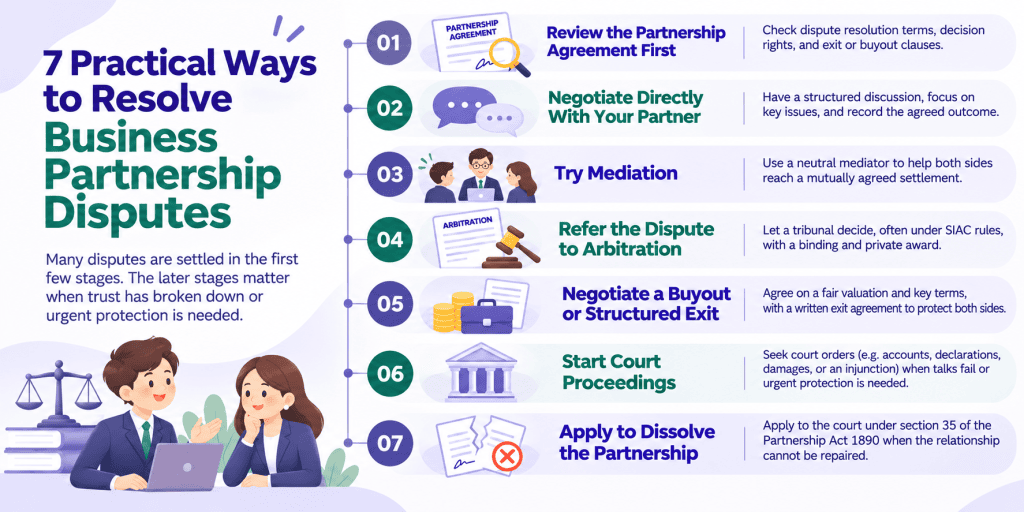
1. Review the Partnership Agreement First
Start with what the partners signed. Look for a dispute resolution clause (such as mediation before litigation), decision-making thresholds, exit and buyout terms, and any power for a majority to remove a partner. A court or tribunal may hold the partners to the agreed process. If there is no written agreement, the default rules in section 24 apply, and a lawyer can help establish what was agreed through conduct and correspondence.
2. Negotiate Directly With Your Partner
A structured conversation resolves many disputes quickly and privately. Put the issues in writing, focus on specifics such as accounts, roles or payments, and keep a record of what is agreed. Partners can vary their terms by consent (section 19). Any outcome should be captured in a signed amendment to the agreement rather than left as an understanding.
3. Try Mediation
In mediation, a neutral mediator helps the partners reach their own settlement. The Singapore Mediation Centre handles commercial disputes, and the Singapore International Mediation Centre handles cross-border ones. Either side can walk away until a settlement is signed.
Courts also expect parties to try. Under Order 5 of the Rules of Court 2021, parties must consider amicable resolution before and during proceedings, and an unreasonable refusal can affect costs. The Singapore Courts describe their own mediation options.
4. Refer the Dispute to Arbitration
If the partnership agreement has an arbitration clause, the dispute generally goes to a tribunal rather than a court, often under Singapore International Arbitration Centre rules. Proceedings are generally private, and the award is binding, with only limited grounds of challenge. Without a clause, arbitration needs both partners’ agreement. Our guide to alternative dispute resolution methods compares the options in more detail.
5. Negotiate a Buyout or Structured Exit
Often the cleanest outcome is that one partner buys the other out. The difficult part is valuation, so agree the method early, ideally with an independent valuer, and address goodwill, client contracts, liabilities and guarantees. If the agreement lets the majority remove a partner, follow its procedure exactly. A written exit agreement with releases and indemnities protects both sides.
6. Start Court Proceedings
When talks fail or urgent protection is needed, a partner may go to court for orders such as:
- an account of the partnership’s dealings
- declarations about rights under the agreement
- damages for breach
- an injunction to stop assets or business being diverted
Court proceedings are generally public, slower and more expensive than mediation or arbitration. They are usually a later step unless there is urgency.
7. Apply to Dissolve the Partnership
Where the relationship cannot be repaired, a partner can apply to the court to dissolve the partnership under section 35 of the Partnership Act 1890. This ends the partnership and is usually a last resort, as explained below.
Also Read: Dispute Resolution in Construction Industry Singapore
Choosing the Right Way to Resolve a Partnership Dispute
The table compares the seven ways at a glance, from the most informal to the most formal.
| Way | Typical use | Relative formality |
|---|---|---|
| Review the agreement | First check of the agreed process and rights | Informal |
| Direct negotiation | Early disagreements between willing partners | Informal |
| Mediation | Stalled talks where partners still want a deal | Low to moderate |
| Buyout or structured exit | One partner wants out or must go | Moderate |
| Arbitration | The agreement contains an arbitration clause | Moderate to high |
| Court proceedings | Urgent relief, or no agreed settlement | High |
| Dissolution | Relationship beyond repair | High |
Dissolution of Partnership in Singapore
Dissolution ends the partnership and is usually a last resort. Under section 35, on a partner’s application, the court may order dissolution where another partner is permanently incapable of performing their part. It may also do so where another partner has engaged in conduct that prejudicially affects the business, or wilfully or persistently breaches the agreement. The court may order it too where the business can only be carried on at a loss, or where it is just and equitable to do so.
After dissolution, partners’ authority continues only as far as needed to wind up the affairs and complete unfinished transactions (section 38). Accounts are settled in the order set by section 44. In Tan Huah Sun v Tan Huah Tai [2022] SGHC 29, the High Court noted that only a partner can apply to dissolve under section 35. An application to wind up a partnership under the Insolvency, Restructuring and Dissolution Act 2018 is more likely to come from a creditor.
Also Read: The Complete Legal Audit Checklist for Singapore Companies (2026)
Shareholder Dispute Resolution Where the Business Is a Company
Many business partners operate through a private limited company, where the Partnership Act does not apply and different remedies are available. A shareholder who is treated unfairly may seek relief for oppression under section 216 of the Companies Act 1967, and the court has wide powers, including ordering a buyout of shares.
Our guide to minority shareholder oppression explains how this works. Fiduciary duties are often central where a director has acted for their own benefit.
How to Prevent Business Partnership Disputes
A clear written partnership agreement is the best protection. It should set out each partner’s role, capital and profit share, decision-making thresholds and how deadlocks are broken. It should also include a dispute resolution clause (for example mediation followed by arbitration) and a buyout and removal mechanism. Regular accounts, written records of major decisions and prompt updates to the agreement when roles change also stop small disagreements from becoming legal disputes.
When to Speak to a Partnership Dispute Lawyer
It is sensible to take advice early, for example when a partner withholds accounts, money or assets appear to be going missing, or a partner is competing with the business. The same applies if you are being asked to sign an exit document or are unsure what your agreement means. Early advice generally keeps more options open, including mediation and a negotiated buyout.
A partnership dispute lawyer can review your agreement and records and explain your rights under the Partnership Act or the Companies Act. The lawyer can also advise whether negotiation, mediation, arbitration or court action is the better route, and move quickly if urgent orders are needed.
Get Legal Support for Your Business Partnership Dispute
Every partnership dispute turns on its own agreement, structure and facts. Ramesh Bharani Nagaratnam and the team at RBN Chambers advise business owners on partnership and shareholder disputes, from reviewing agreements and negotiating exits to mediation, arbitration and court proceedings.
To discuss your situation, learn more about our lawyer services at RBN Chambers or contact us to arrange a consultation.
Frequently Asked Questions
What is the first step in resolving a business partnership dispute?
Check the partnership agreement for a dispute resolution clause and the agreed rules on decisions, accounts and exit. Then raise the issues in writing with your partner and, if needed, take legal advice before the dispute escalates.
Can a business partner be removed without their consent in Singapore?
Not by majority vote unless the partnership agreement expressly allows it (section 25 of the Partnership Act 1890). Even where it does, the procedure in the agreement must be followed carefully.
Is mediation compulsory before going to court?
Not by default, but the partnership agreement may require it. In litigation, parties must consider amicable resolution under Order 5 of the Rules of Court 2021, the court may order them to attempt it, and an unreasonable refusal can affect costs.
How can a partnership be dissolved in Singapore?
Partners can agree to end it, a partnership with no fixed term can be ended by notice (section 32), or a partner can apply to the court under section 35. Companies and limited liability partnerships follow different procedures.

Delivering Solutions not just Answers to your legal disputes
We provide solutions to all our clients regardless of the scale or complexity of the cases. Let us know how we can help.
Contact UsAny information of a legal nature in this blog is given in good faith and has been derived from resources believed to be reliable and accurate. The author of the information contained herein this blog does not give any warranty or accept any responsibility arising in any way, including by reason of negligence for any errors or omissions herein. Readers should seek independent legal advice.