

Employment |
Compassionate Leave in Singapore: Legal Rights and Rules

Compassionate leave in Singapore is not a right under the Employment Act. Whether you can take time off after a death in the family, for how many days and whether you are paid all depend on your employment contract, staff handbook or agreement with your employer.
That does not leave employees without options. Many employers do grant compassionate leave, and where a contract or policy promises it, the wording can be enforced. This guide explains how the rules work for both sides, including what to do if a request is refused.
What is compassionate leave in Singapore?
Compassionate leave in Singapore is time off that an employer allows so that an employee can deal with a family crisis. It is usually paid or unpaid leave that is used when a family member dies, and it may also cover a family member’s serious illness.
In everyday use, compassionate leave and bereavement leave mean the same thing, although compassionate leave is the wider label. Which events count is for the policy to define, because the law does not.
Is compassionate leave compulsory in Singapore?
No. MOM’s annual leave guidance states that there is no statutory entitlement to compassionate leave and that any entitlement depends on your employment contract or mutual agreement with your employer. If you have none, you can apply for annual leave or unpaid leave instead. That sets it apart from annual leave, sick leave and childcare leave, which legislation provides for eligible employees.
Because compassionate leave is so common, many people assume it is mandatory. MOM’s Conditions of Employment 2024 survey found that 85.3% of surveyed establishments offered paid compassionate leave, but it covered only private employers with at least 25 employees and the public sector, so smaller businesses may have no policy. The Government has also chosen not to legislate. In its 2021 reply to Parliament on bereavement and caregiver leave, MOM cited the cost to employers and the employability of caregivers, and its February 2026 reply on eldercare leave again favoured flexible work arrangements.
Who is eligible for compassionate leave in Singapore?
With no statutory test, eligibility is whatever the employer has agreed to. The documents to read are your employment contract and any staff handbook or HR policy that forms part of it. Being covered by the Employment Act does not create a right to compassionate leave.
Policies usually settle who qualifies, such as full-time staff or only those past probation, which relatives are covered, and what proof is needed, such as a death certificate or funeral notice. Where the policy is silent, leave becomes a matter of agreement or discretion rather than entitlement.
Also Read: Flexi Work Arrangement Singapore: Your Legal Rights
How many days of compassionate leave do you get in Singapore?
MOM sets no number of days, so how long compassionate leave lasts comes from your contract or policy. Many Singapore employers grant between two and five paid days, often more for a spouse, child or parent than for other relatives, but that is market practice rather than a legal standard.
A government example shows how a policy can be structured. The CMPB’s rules for Police full-time national servicemen allow up to three working days for events such as the death of a spouse, child, parent, parent-in-law, sibling or grandparent. Vacation leave is used if three days are not enough, and up to four more working days may be granted if vacation leave runs out. This is one organisation’s rule, not a benchmark every employer must follow.
Does compassionate leave include weekends?
It depends on the wording. Some policies count working days, so weekends and public holidays do not use up leave, while others count consecutive calendar days. MOM’s annual leave guidance offers a comparison: leave taken on a half working day, such as a Saturday ending at 1pm, still counts as a full day unless the employer chooses to treat it as a half day. Whether a company applies the same approach to compassionate leave is a policy question. The table below sets out what to check.
| Issue | What to check | Why it matters |
|---|---|---|
| Working days or calendar days | Whether the policy says “working days” or simply “days” | Decides whether weekends and public holidays use up leave |
| Time limit | Whether leave must be taken within a set period of the death | Late requests may fall outside the policy |
| Overseas funerals | Whether extra travel time or unpaid leave is allowed | Arrangements abroad often need more than the standard days |
Compassionate leave for in-laws and grandparents
Whether a father-in-law, mother-in-law or grandparent is covered depends on the policy. Many policies include a spouse, child, parent and sibling, and some extend to parents-in-law and grandparents, while others limit leave to the closest relatives or give fewer days for extended family. In practice, employer policies are generally not limited to parents or grandparents but extend to close family members.
If your father-in-law or grandparent passes away and your policy does not name them, request leave in writing, explain the relationship and circumstances, and be ready to use annual leave or unpaid leave as a fallback.
Paid and unpaid compassionate leave
Pay follows the contract. Where a policy offers paid compassionate leave, salary is unaffected for those days. Where it offers unpaid leave or none, employees can ask to use paid annual leave or apply for unpaid leave, which needs the employer’s approval. If an employer deducts salary for days the contract describes as paid compassionate leave, that goes beyond a policy disagreement and may amount to a contractual salary dispute.
Can an employer refuse compassionate leave?
Where no contract term or policy gives an entitlement, an employer is generally free to decline, although most would rather accommodate a bereavement. Refusal is harder to justify where the contract says leave will be granted, because that is a term the employer must honour, and a staff handbook can have the same effect if it forms part of the contract.
Where leave is “at management’s discretion”, Singapore courts have held in a discretionary bonus case, BGC Partners (Singapore) Ltd v Sumit Grover [2024] SGHC 206, that employers must exercise a contractual discretion reasonably and not arbitrarily, capriciously or irrationally, although courts do not lightly interfere. Whether that reasoning applies to a leave clause depends on its wording and the facts.
What the employee does next matters just as much. Under section 13(2) of the Employment Act 1968, an employee absent for more than two days continuously without prior leave, and without a reasonable excuse or without informing or attempting to inform the employer, is deemed to have broken the contract. The employer may then terminate without notice, and the employee may owe salary in lieu of notice. Telling your employer immediately, even before leave is approved, protects your position.
Also Read: Retrenchment in Singapore: Rights, Benefits and Legal Process
What employees and employers should check
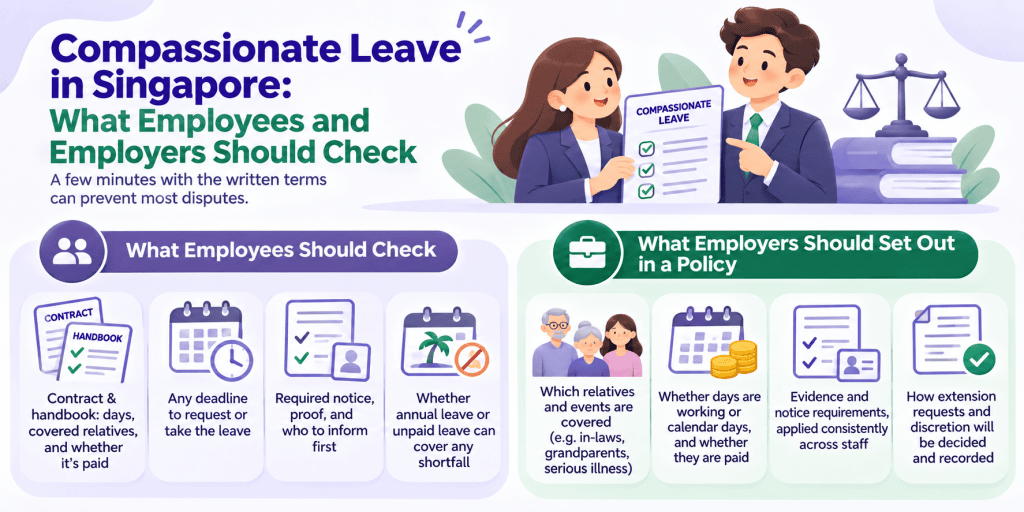
A few minutes with the written terms can prevent most disputes.
What employees should check
- The contract and handbook for the number of days, covered relatives and whether the leave is paid
- Whether leave must be requested or taken within a set period after the death
- The notice and proof the employer expects, and who to inform first
- Whether annual leave or unpaid leave can cover any shortfall
What employers should set out in a policy
- Which relatives and events are covered, including in-laws, grandparents and serious illness
- Whether days are working or calendar days, and whether they are paid
- Evidence and notice requirements, applied consistently across staff
- How extension requests and discretion will be decided and recorded
Resolving a compassionate leave dispute
Start with the written terms, and put your request or concern to HR or your manager in writing, keeping the messages. If the issue is unpaid salary, such as pay deducted for leave the contract treats as paid, TADM provides advisory and mediation services, and salary-related claims must be mediated there before they can go to the Employment Claims Tribunals. Claims are generally capped at $20,000, with time limits of one year after the dispute arose if you are still employed, or six months from your last day of work.
Whether a claim fits the Tribunals depends on the contract’s wording, and disputes over what a clause means, or involving larger sums, may need legal advice and the civil courts.
When legal advice on compassionate leave is worth getting
Most compassionate leave issues are settled with a conversation, but legal advice is worth considering when the contract wording is unclear, a request has been refused despite a written entitlement, salary has been deducted, or an absence has led to a warning or termination. Employers also benefit from advice when drafting or revising leave clauses, so that coverage, counting rules and discretion are clear before a bereavement happens.
RBN Chambers advises employees and employers on employment contracts, workplace policies and employment disputes. Our guide to employee rights in Singapore gives wider context on entitlements under the Employment Act.
Speak to an employment lawyer at RBN Chambers
If you are an employee dealing with a refused request, a salary deduction or a warning, or an employer reviewing a leave policy or employment contract, RBN Chambers can help you understand your position and options. Our lawyers, led by Ramesh Bharani Nagaratnam, act in employment disputes and advise on contractual and policy issues, including leave and termination.
To discuss your situation, visit our employment disputes page or contact us to arrange a consultation with the team at RBN Chambers.
Frequently Asked Questions
Can an employer refuse compassionate leave?
If no contract term or policy gives you the leave, generally yes. If your contract promises it, refusal may breach the contract, and you may want legal advice.
Can part-time or contract employees take compassionate leave?
It depends on the employment contract or policy. Being covered by the Employment Act does not create a right to compassionate leave, so check whether your employment type is included.
Can unused compassionate leave be carried forward or paid out?
Compassionate leave is usually tied to a specific event rather than accrued like annual leave, so unused days are not normally carried forward or paid out unless your contract says otherwise.

Delivering Solutions not just Answers to your legal disputes
We provide solutions to all our clients regardless of the scale or complexity of the cases. Let us know how we can help.
Contact UsAny information of a legal nature in this blog is given in good faith and has been derived from resources believed to be reliable and accurate. The author of the information contained herein this blog does not give any warranty or accept any responsibility arising in any way, including by reason of negligence for any errors or omissions herein. Readers should seek independent legal advice.