

Business |
Shareholder Disputes in Singapore: Causes & How to Resolve Them

Shareholder disputes can paralyse a Singapore company, leading to costly litigation and reputational damage. Whether it stems from a breach of a shareholders’ agreement, a boardroom deadlock, or minority oppression under the Companies Act, understanding your legal standing early is critical.
Below, we break down the most common causes of shareholder disputes, the legal remedies available under Singapore law, and how RBN Chambers helps businesses and shareholders resolve them strategically.
Common Causes of Shareholder Disputes in Singapore
Disputes between shareholders rarely come out of nowhere. They usually trace back to a handful of recurring triggers, most of which can be traced to gaps in a company’s founding documents or a breakdown in trust between the people running it.
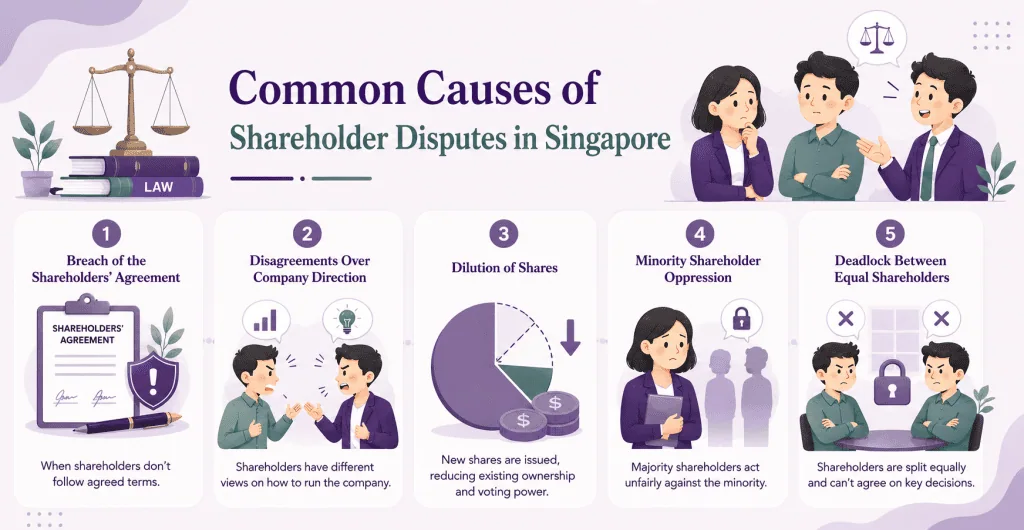
Breach of the Shareholders’ Agreement
A shareholders’ agreement sets out the rights, duties, and obligations of a company’s shareholders, including the number of shares issued, restrictions on share transfers, pre-emptive rights, and each shareholder’s percentage ownership. It is a legally binding contract. When one or more shareholders fail to honour its terms, the other shareholders may have grounds to sue for breach.
Disagreements Over Company Direction
Shareholders often clash over how a company should be run, from allocation of resources and investment strategy to the hiring of key personnel. These disagreements are common in closely-held companies where two or three shareholders hold equal or near-equal influence, and left unresolved, they can cripple decision-making at the board level.
Dilution of Shares
Dilution occurs when a company issues additional shares, typically to raise capital or bring in new investors, or as a result of a merger or restructuring. This reduces the percentage ownership, and correspondingly the voting power, of existing shareholders. Where a dilution exercise is carried out without properly informing or consulting existing shareholders, it frequently becomes a flashpoint for disputes.
Minority Shareholder Oppression
Minority shareholders, those holding less than 50% of a company’s shares, have less influence over how the company is run and can be outvoted by the majority. Where majority shareholders use that control to act unfairly toward the minority, for example by withholding information, diverting business opportunities, or excluding a shareholder from management, this can amount to oppression under Singapore law.
Deadlock Between Equal Shareholders
Deadlock arises when shareholders, often in a 50/50 joint venture or family business, are evenly split and unable to agree on material decisions. Unlike oppression, deadlock does not necessarily involve unfair conduct by either side; it simply means the company can no longer function because no resolution can be passed. Left unresolved, a genuine deadlock can bring a company’s operations to a standstill.
Also Read: What to Include in a Singapore Partnership Agreement
Legal Remedies for Shareholder Disputes in Singapore
Singapore law gives aggrieved shareholders several routes to relief, and the right one depends heavily on whether the wrong is personal to the shareholder or done to the company itself, and on how serious the breakdown is.
Section 216 Relief for Minority Oppression
Under Section 216 of the Companies Act 1967, a shareholder who has been unfairly prejudiced or oppressed can apply to the High Court for relief in their own name. The court has broad discretion and is not limited to what the applicant specifically asks for. In Suying Design Pte Ltd v Ng Kian Huan Edmund [2020] SGCA 32, the Court of Appeal found that diverting business opportunities to entities controlled by the majority shareholders amounted to oppression.
Notably, even an equal (50%) shareholder can bring a Section 216 claim if they lack the practical power to stop the conduct complained of, as confirmed in Ascend Field Pte Ltd v Tee Wee Sien [2020] SGCA 14.
Derivative Action Under Section 216A
Where the wrong is done to the company rather than to an individual shareholder, for example a breach of fiduciary duty by a director, a shareholder may apply to bring a statutory derivative action under Section 216A. This allows the shareholder to sue in the company’s name, with any remedy benefiting the company rather than the individual.
Court-Ordered Buy-Out
The most commonly sought remedy in both oppression and deadlock cases is a court-ordered buy-out, where one party is directed to purchase the other’s shares at fair value, generally without a discount for the shares being a minority stake. This allows the aggrieved shareholder to exit cleanly without forcing the company to close.
Injunctions and Corporate Regulation
The court can also order an injunction to stop or prevent a specific act, such as an unauthorised share issuance or a board resolution passed improperly. In less severe cases, the court may instead direct changes to the company’s constitution or governance arrangements to correct the underlying problem going forward.
Just and Equitable Winding Up
Where the relationship between shareholders has broken down irretrievably and no other remedy is realistic, typically in a genuine, terminal deadlock, a shareholder may petition the High Court to wind up the company on the basis that it is “just and equitable” to do so.
This ground for winding up now sits within Singapore’s insolvency legislation rather than the Companies Act alone, and courts treat it strictly as a last resort. It is not available simply because a shareholder wants to exit, or because the breakdown in trust was self-induced.
Preventing Shareholder Disputes Before They Start
Many of the disputes above are avoidable with the right documentation in place from the outset. A well-drafted shareholders’ agreement anticipates the points of friction, rather than leaving them to be argued out after a falling-out has already happened.
- A clear shareholders’ agreement covering share transfer restrictions, pre-emptive rights, and reserved matters requiring unanimous or supermajority approval.
- A deadlock-breaking mechanism, such as a casting vote, tie-breaker director, or a shotgun/buy-sell clause, built in before a 50/50 structure is used.
- A dispute resolution clause specifying whether disagreements go to mediation, arbitration, or the courts, and under which rules.
- Regular corporate governance practices, including proper board minutes, timely financial disclosures, and documented shareholder approvals for major decisions.
How Shareholder Disputes Are Resolved in Singapore
Once a dispute has arisen, shareholders generally have three options, and the right choice depends on cost, speed, and how much confidentiality the parties want to preserve.
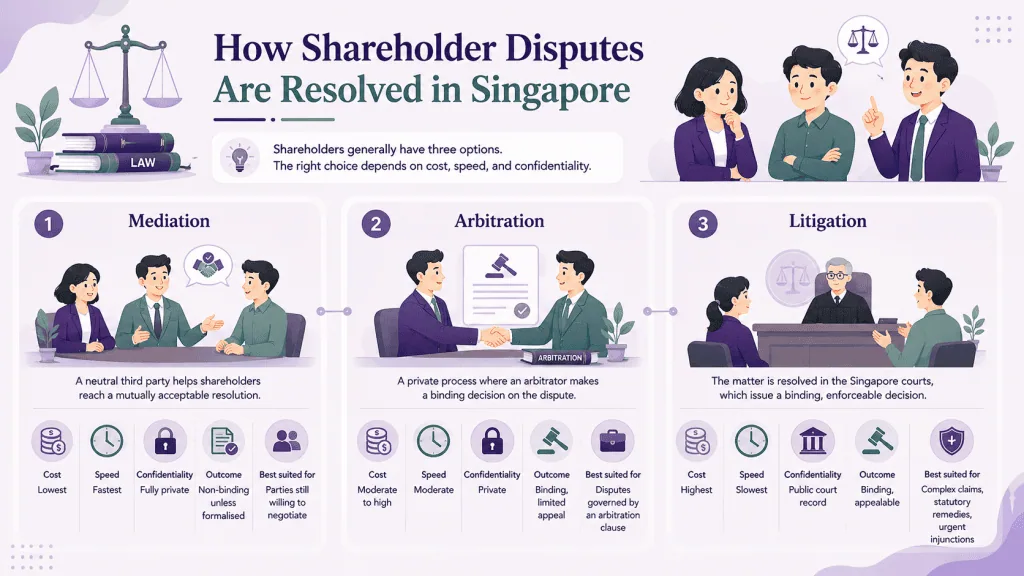
Mediation
Mediation is a private, informal process in which a neutral third party helps shareholders reach a mutually acceptable resolution. It preserves business relationships and confidentiality, and is often the fastest and least expensive route where the parties are still willing to talk.
Arbitration
If the shareholders’ agreement contains an arbitration clause, disputes may need to be resolved through arbitration rather than the courts. Arbitration produces a binding decision, is conducted privately, and allows the parties to select an arbitrator with relevant commercial expertise.
Litigation
Where mediation fails, no arbitration clause applies, or the dispute involves complex legal questions such as a Section 216 or winding-up application, the matter proceeds to the Singapore courts. Litigation is public and typically the most expensive and time-consuming route, but it is sometimes the only way to obtain a binding, enforceable outcome, particularly for remedies like a court-ordered buy-out or winding up.
| Key Point | Mediation | Arbitration | Litigation |
|---|---|---|---|
| Cost | Lowest | Moderate to high | Highest |
| Speed | Fastest | Moderate | Slowest |
| Confidentiality | Fully private | Private | Public court record |
| Outcome | Non-binding unless formalised | Binding, limited appeal | Binding, appealable |
| Best suited for | Parties still willing to negotiate | Disputes governed by an arbitration clause | Complex claims, statutory remedies, urgent injunctions |
Our commercial litigation, civil litigation, and arbitration teams work across all three routes, and we typically advise on the most cost-effective path before recommending court proceedings.
When to Consult a Shareholder Dispute Lawyer
Not every disagreement between shareholders needs a lawyer, but certain warning signs suggest it is time to get advice before positions harden further.
- You have been excluded from board meetings, decisions, or access to company records.
- Shares are being issued, diluted, or transferred without your knowledge or consent.
- A co-shareholder has diverted business, clients, or company funds for personal benefit.
- The company can no longer pass resolutions because shareholders are deadlocked.
- You are considering exiting the company but cannot agree on a fair buy-out price.
Acting early, before a dispute escalates into a formal claim, usually gives shareholders more options and a stronger negotiating position.
Also Read: Essential Shareholder Agreement Clauses in Singapore
Talk to RBN Chambers About Your Shareholder Dispute
Shareholder disputes are disruptive, and left unresolved, they can affect a company’s productivity, its finances, and its reputation. The earlier a dispute is identified and addressed, whether through a shareholders’ agreement review, mediation, or formal legal action, the more options are available to resolve it on favourable terms.
For advice on a shareholder dispute or other corporate matter, get in touch with Ramesh Bharani Nagaratnam, Managing Director of RBN Chambers and an experienced litigation and arbitration lawyer with over 13 years in law and accountancy. Contact us to find out how our team can help.
Frequently Asked Questions
What are the most common causes of shareholder disputes in Singapore?
The most common causes are breach of a shareholders’ agreement, disagreements over company direction, dilution of shares, minority shareholder oppression, and deadlock between equal shareholders.
Can a minority shareholder sue a majority shareholder in Singapore?
Yes. A minority shareholder can apply to the High Court for relief under Section 216 of the Companies Act if the majority’s conduct amounts to oppression or unfair prejudice, and can pursue a derivative action under Section 216A if the wrong was done to the company itself.
How do you resolve a 50/50 shareholder deadlock?
Deadlock is typically resolved through a pre-agreed mechanism such as a casting vote or buy-sell clause, or through mediation or arbitration. Where the deadlock is irreparable and no other remedy works, a shareholder can petition the court to wind up the company on just and equitable grounds.
Is litigation the only way to resolve a shareholder dispute?
No. Most shareholder disputes in Singapore are resolved through mediation or arbitration before reaching the courts. Litigation is generally reserved for cases requiring a binding statutory remedy, such as an oppression claim or a winding-up order.

Delivering Solutions not just Answers to your legal disputes
We provide solutions to all our clients regardless of the scale or complexity of the cases. Let us know how we can help.
Contact UsAny information of a legal nature in this blog is given in good faith and has been derived from resources believed to be reliable and accurate. The author of the information contained herein this blog does not give any warranty or accept any responsibility arising in any way, including by reason of negligence for any errors or omissions herein. Readers should seek independent legal advice.