

Employment |
Wrongful Dismissal in Singapore Law: Employee and Employer Guide

Wrongful dismissal is a pressing concern for both employers and employees in Singapore. A dismissal is considered wrongful when it breaches the terms of an employment contract or fails to comply with statutory requirements under Singapore law.
Recent legal developments and cases have provided further clarity on what constitutes wrongful dismissal and the rights of affected parties.
This article aims to provide an overview of the concept, the legal framework, and key considerations for employers and employees.
What Constitutes Wrongful Dismissal?
Wrongful dismissal occurs when an employer terminates an employee without just cause or excuse, or in a way that breaches the employment contract. Common examples include:
- Dismissal without notice of termination: Employers must give the notice period stated in the contract, or pay in lieu. For employees under the Employment Act, the statutory minimum runs from one day to four weeks depending on length of service. Skipping this can itself support a wrongful dismissal claim.
- Dismissal without a fair inquiry for misconduct: Where an employer alleges theft, insubordination, or similar misconduct, it must hold a fair inquiry first, putting the allegations to the employee and giving them a genuine chance to respond. Skipping this step can make a dismissal wrongful even if the misconduct did occur.
- Summary dismissal that isn’t justified: The Employment Act allows dismissal without notice for serious misconduct, but the employer carries the burden of proving it. If they can’t, the dismissal is treated as wrongful.
- Dismissal on discriminatory or retaliatory grounds: The Tripartite Guidelines on Wrongful Dismissal also treat termination based on age, race, gender, religion, or family responsibilities as wrongful, as is dismissing someone for exercising an employment right, such as filing a TADM claim, or to avoid paying benefits like maternity pay.
- Dismissal for a false reason: If an employer gives a reason for termination that turns out not to be true, the dismissal is wrongful even though notice was given.
Wrongful Dismissal vs Unfair Dismissal in Singapore
These terms are often used interchangeably, and in everyday conversation that’s usually fine. But there’s a real legal distinction worth knowing, especially if you’re deciding where to bring a claim.
| Key Difference | Statutory Wrongful Dismissal | Common Law Wrongful Dismissal |
|---|---|---|
| Legal basis | Section 14(2) of the Employment Act | Breach of a specific employment contract term |
| What it covers | Termination without just cause or excuse, what most people mean by “unfair dismissal” in a Singapore context | Breach of a contract term, most often the notice period |
| Where it’s heard | TADM mediation, then the Employment Claims Tribunals (ECT) | Ordinary courts |
| Compensation | Capped under ECT rules (see compensation table above) | Generally limited to salary for the unpaid notice period, per Wee Kim San Lawrence Bernard v Robinson & Co (Singapore) Pte Ltd [2014] 4 SLR 357 |
| Best suited to | Dismissals that are unjustified, discriminatory, or lack due process | Higher-value contractual disputes, e.g. an unpaid notice period on a large salary |
In short: if your dismissal was unjustified or discriminatory, you’re looking at a statutory wrongful dismissal claim through TADM and the ECT. If your dispute is purely about a breached contract term, a civil claim may apply instead.
Also Read: Workplace Dispute Resolution in Singapore: Options and Steps
Legal Framework Governing Wrongful Dismissal
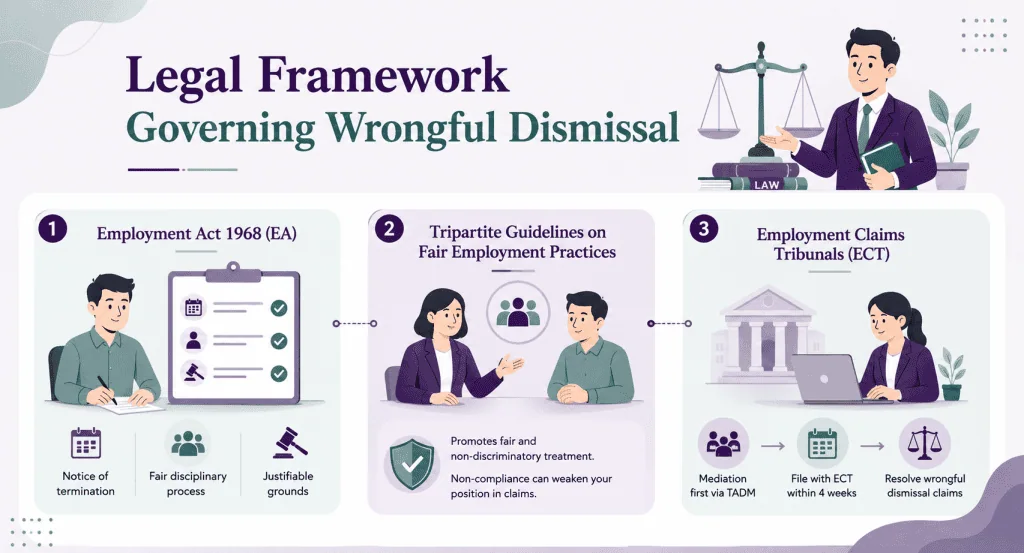
Employment Act 1968 (EA)
The Employment Act governs the majority of employment relationships in Singapore, covering all employees except for seafarer, domestic worker and statutory board employee or civil servant. For cases of wrongful dismissal, the Act outlines key provisions, including:
- Notice of Termination: Employers must adhere to the notice period specified in the employment contract or pay compensation in lieu of notice. Failure to do so may be considered wrongful dismissal.
- Disciplinary Process: If an employee is dismissed due to misconduct, employers are expected to conduct a fair inquiry before termination. The lack of such an inquiry could lead to a finding of wrongful dismissal.
- Grounds for Dismissal: The employer must provide justifiable reasons for the dismissal, especially if it is with immediate effect. This requirement helps ensure transparency and fairness.
Tripartite Guidelines on Fair Employment Practices
While not legally binding, the Tripartite Guidelines issued by the Ministry of Manpower (MOM), the National Trades Union Congress (NTUC), and the Singapore National Employers Federation (SNEF) serve as an important reference for fair employment practices.
The guidelines emphasize non-discriminatory practices and fair treatment of employees, advising employers to provide clear reasons for termination. Non-compliance with these guidelines can adversely affect the employer’s standing in wrongful dismissal claims.
Employment Claims Tribunals (ECT)
Employees who believe they have been wrongfully dismissed can seek recourse through the Employment Claims Tribunals (ECT). The ECT provides a streamlined process for resolving disputes related to salary and wrongful dismissal claims.
Notably, before filing a wrongful dismissal claim with the ECT, employees must first attempt mediation through the Tripartite Alliance for Dispute Management (TADM). If the mediation is unsuccessful, a claim can then be filed with the ECT, but this must be done within four weeks of the mediation’s failure.
How Much Compensation Can You Claim for Wrongful Dismissal
This is one of the most searched questions on this topic, and it’s worth being precise about, since the ECT’s compensation formula is set out in the Second Schedule of the Employment Claims Regulations 2017.
| Component | How it’s calculated |
|---|---|
| Loss of income | Up to 3 months of your gross rate of pay on the date of dismissal |
| Harm caused | Up to 2 months of your gross rate of pay, adjusted up or down based on the factors below |
| Overall claim cap | $20,000 per claim, or $30,000 if assisted by a union |
| Combined claims | The cap may be doubled if a wrongful dismissal claim is filed together with a separate salary claim |
The “harm” component isn’t automatic. The ECT adjusts it based on:
- Aggravating factors that increase the award, such as a humiliating or degrading dismissal, false accusations used to justify the termination, or deliberate steps by the employer to damage the employee’s future job prospects.
- Mitigating factors that reduce it, such as genuine misconduct or insubordination on the employee’s part.
In practice, this means an employee earning a high salary won’t necessarily recover more than the statutory cap, and reinstatement, while available in theory, remains rare in ECT decisions.
Recent Wrongful Dismissal Rulings in Singapore
Two recent ECT decisions show how these principles play out.
- In a July 2026 ruling, an audit manager dismissed at the end of her six-month probation was awarded the maximum $30,000, even though her earnings would have entitled her to more under the uncapped formula. The tribunal found her employer had failed to justify ending her employment and that the manner of dismissal was sudden and unjustified. The case is a useful reminder that probationary employees are protected under the same wrongful dismissal framework as confirmed staff.
- In a 2026 misconduct case covered by Baker McKenzie, the ECT applied a principle of proportionality to a dismissal based on suspected dishonest medical-claims behaviour. The tribunal found the employer’s evidence didn’t actually establish the dishonesty it alleged, and ordered a payout covering lost income, harm, and costs. The decision confirms that the ECT will scrutinise whether an employer’s stated reason for dismissal is actually supported by evidence, not just asserted.
The Wrongful Dismissal Claims Process
For employees considering a claim, the process generally runs as follows.
- Raise the issue internally, if there’s a reasonable avenue to do so, and gather documentation of your dismissal.
- File for mediation with TADM, generally within one month of your last day of employment.
- Attend TADM mediation, where an officer helps both parties try to reach a settlement.
- File with the ECT within four weeks if mediation doesn’t resolve the dispute.
- Attend the ECT hearing, where a tribunal magistrate decides on compensation or, in rare cases, reinstatement.
Employer’s Guide Best Practices to Avoid Wrongful Dismissal Claims
- Document performance issues as they happen, and communicate them clearly before termination is considered.
- Use a Performance Improvement Plan before dismissing for underperformance. A well-run PIP sets clear expectations, offers support, and gives a reasonable timeframe, evidence that the employer acted in good faith.
- Run a fair, transparent inquiry before any misconduct dismissal, and give the employee a genuine opportunity to respond.
- Make sure the reason for dismissal is provable, not just asserted. Recent ECT decisions show the tribunal will test whether the employer’s evidence actually supports its stated grounds.
- State termination reasons clearly, and keep them consistent, non-discriminatory, and tied to documented performance or conduct issues.
Employee’s Guide What to Do If You Suspect Wrongful Dismissal
- Review your employment contract, including your employee rights, notice period, and stated grounds for termination.
- Seek advice early. A lawyer or TAFEP can help you assess the strength of your case before deadlines start running.
- File for mediation with TADM, and escalate to the ECT if it doesn’t resolve. If you were dismissed while pregnant, you have two months from the birth of your child rather than one month from dismissal.
- Keep records of everything related to your termination, including warning letters, emails, and the termination letter itself.
Also Read: Salary Deduction Rules in Singapore: Excess MC & Legal Limits
Getting the Right Advice on Wrongful Dismissal at RBN Chambers
Wrongful dismissal carries real financial and reputational risk for employers, and real uncertainty for employees navigating an already difficult moment. Understanding where the legal lines sit, from notice requirements and fair inquiry to the ECT’s compensation formula, is the first step to protecting your position, whichever side of the dismissal you’re on.
If you’re an employer looking to review your termination process, or an employee weighing whether to file a claim, RBN Chambers‘ employment disputes team, led by Ramesh Bharani Nagaratnam, can assess your situation and advise on next steps. Reach out to us to discuss your case.
Frequently Asked Questions
Can I be dismissed without reason during probation in Singapore?
No. Probationary employees are still protected against wrongful dismissal. A recent ECT ruling awarded the maximum $30,000 compensation to a probationary employee whose employer failed to justify her dismissal at the end of her probation period.
How much compensation can I get for wrongful dismissal in Singapore?
The ECT can award up to three months’ gross pay for loss of income and up to two months’ gross pay for harm caused, subject to an overall cap of $20,000 per claim, or $30,000 with union assistance. The cap may be doubled if a salary claim is filed alongside the wrongful dismissal claim.
What is the difference between wrongful dismissal and unfair dismissal?
In Singapore, these terms are largely used interchangeably. Statutory “wrongful dismissal” under the Employment Act covers what other jurisdictions call unfair dismissal, termination without just cause or excuse. A narrower common law version of wrongful dismissal deals specifically with breach of contract terms, such as notice periods, and is heard in the ordinary courts rather than the ECT.
How long do I have to file a wrongful dismissal claim?
Generally, you have one month from your last day of employment to start mediation with TADM, extending to two months if you were dismissed during pregnancy. If mediation fails, you then have four weeks to file with the ECT.
If I resign because of my employer’s conduct, can I still claim wrongful dismissal?
Yes. This is called constructive dismissal. If your employer’s conduct, such as a unilateral pay cut, demotion without cause, or a hostile work environment, effectively forced your resignation, it’s treated as wrongful dismissal under the same TADM and ECT process.
Can my employer dismiss me while I’m on medical leave?
Employers should be cautious here. Dismissing an employee to avoid paying medical benefits or during protected leave can itself be treated as wrongful dismissal under the Tripartite Guidelines, particularly where the timing suggests the leave was the real reason for termination.

Delivering Solutions not just Answers to your legal disputes
We provide solutions to all our clients regardless of the scale or complexity of the cases. Let us know how we can help.
Contact UsAny information of a legal nature in this blog is given in good faith and has been derived from resources believed to be reliable and accurate. The author of the information contained herein this blog does not give any warranty or accept any responsibility arising in any way, including by reason of negligence for any errors or omissions herein. Readers should seek independent legal advice.