

Business |
The Complete Legal Audit Checklist for Singapore Companies (2026)

A director opens an email flagging a missing contract clause. The same week, a staff member forwards a customer invoice through WhatsApp to a personal phone. Neither issue looks serious on its own, but both raise the same question: is the company actually meeting its ACRA filing duties, its obligations under the Employment Act, and its PDPA responsibilities?
A legal audit checklist for Singapore companies is how directors answer that question before a regulator, an employee dispute, or a contract claim forces the issue. Understanding where you stand before someone else points it out, is the whole point of the exercise.
What Is a Legal Compliance Audit?
A legal compliance audit is a structured review of how well a business meets its legal and regulatory obligations. For Singapore companies, this typically spans corporate governance, employment practices, personal data handling, commercial contracts, and any sector-specific rules that apply.
It is not a numbers exercise. A proper regulatory compliance review looks at whether company records are in order, whether internal policies match current law, and whether day-to-day operations create avoidable risk gaps in board approvals, incomplete employment documentation, weak consent management, or contract terms that no longer reflect how the business actually operates.
Treat it as a health check rather than an adversarial process. The goal is a clear, current picture of where the company stands, and a prioritised list of what to fix next.
Why Your Business Needs a Legal Audit
Singapore businesses operate in a closely regulated environment. Companies must comply with the Companies Act, employment rules under the Employment Act and MOM guidelines, and data protection obligations under the Personal Data Protection Act (PDPA). Depending on the industry, licensing or sector-specific rules may apply on top of that.
A company legal audit helps directors and compliance officers catch problems while they’re still cheap to fix. It also supports better governance, clearer reporting lines, and stronger internal controls — which matters more, not less, as the business grows, hires, collects customer data, or signs increasingly complex contracts.
Also Read: How to Legally Start a Business in Singapore (2026)
Conducting a Legal Risk Assessment
A legal risk assessment identifies where the business is most likely to face exposure. Typical risk areas: late ACRA filings, unsigned employment contracts, thin confidentiality clauses, weak vendor terms, and unclear data retention practices.
Three questions do most of the work when assessing risk:
- What legal obligation applies here?
- What happens if we do nothing?
- How likely is this to surface through a dispute, an inspection, or a complaint?
This ordering helps prioritise. A missed director resolution is usually less urgent than a data breach response gap, but both should be logged and addressed on a schedule.
Strengthening Your Corporate Governance Audit
A corporate governance audit examines how decisions get made and recorded: board minutes, annual filings, the share register, the register of controllers where applicable, and approval processes for major decisions.
Good governance protects the company and its directors. It shows decisions were made on the record, not by assumption and it removes a lot of friction when investors, banks, or counterparties eventually ask for those records.
| Audit Category | Key Legislation | Risk Level |
|---|---|---|
| Corporate governance | Companies Act, ACRA filing rules | High |
| Employment law | Employment Act, MOM guidelines | High |
| Data protection | PDPA, PDPC advisories | High |
| Contract compliance | Contract law, sector-specific regulations | Medium |
The Core Legal Audit Checklist Singapore Businesses Need
The checklist below is a practical audit checklist for Singapore businesses to run across core functions. It isn’t limited to large corporations small companies and startups should work through it too, especially once they start hiring, collecting customer data, or scaling operations.
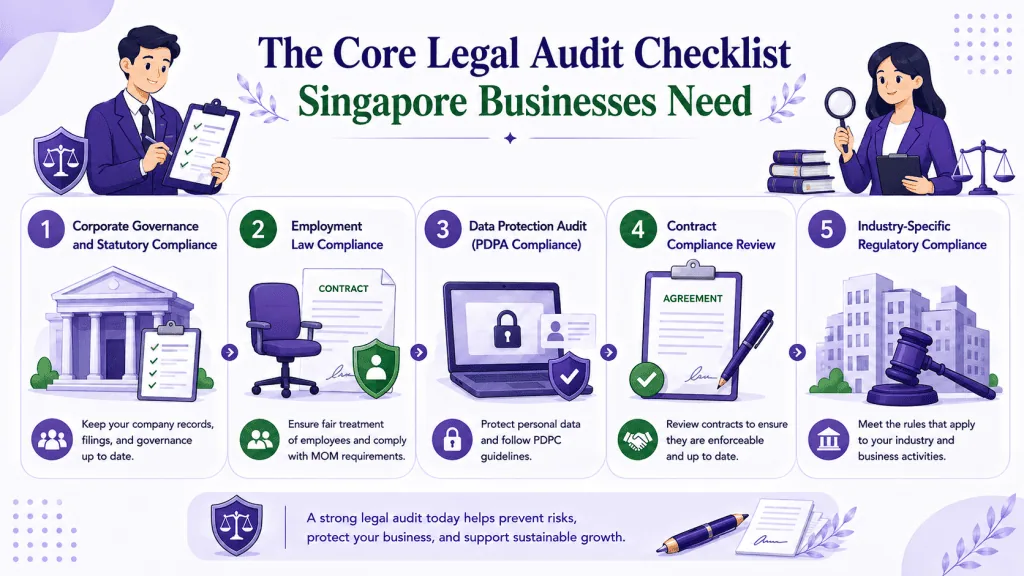
1. Corporate Governance and Statutory Compliance
Start with the company’s basic legal health. Under the Singapore Companies Act and ACRA requirements, confirm:
- Annual returns have been filed on time.
- Company registers are accurate and up to date.
- Directors, shareholders, and officers are properly recorded.
- Board resolutions are documented for key decisions.
- Financial year-end dates and filing timelines are being tracked.
- Registered office details and company particulars are current.
Incomplete records are rarely just an admin problem they can affect due diligence, financing, and enforceability.
2. Employment Law Compliance
Employment issues are one of the most common sources of legal risk in Singapore. A proper employment law compliance review should cover:
- Written employment contracts for every employee.
- Job scopes, salary terms, overtime, leave, and notice periods.
- Compliance with the Employment Act where it applies.
- Correct handling of statutory leave and salary payments.
- Clear disciplinary and termination processes.
- Workplace policies on harassment, grievances, and conduct.
MOM guidance matters most when reviewing hours of work, rest days, salary matters, and termination practices. If your team’s day-to-day reality doesn’t match what the contract says, that gap needs fixing on paper, not just in practice.
3. Data Protection Audit (PDPA Compliance)
A data protection audit checks whether the business handles personal data in line with the PDPA and PDPC guidance — especially relevant if you collect customer details, employee records, images, voice recordings, or online enquiries.
Key questions to work through:
- Do you have a clear, published privacy policy?
- Do you collect only the data you reasonably need?
- Are consent, notification, and purpose limitation properly addressed?
- Who can access personal data internally, and why?
- Are data retention and deletion practices documented?
- Is there a response plan in place for data breaches?
Even a small business can face PDPA exposure once customer data starts living in shared inboxes, personal devices, or unsecured spreadsheets.
4. Contract Compliance Review
A contract compliance review checks whether the company’s agreements are current, enforceable, and aligned with how the business actually operates — customer contracts, supplier terms, NDAs, service agreements, and consultancy arrangements.
Check whether your contracts clearly address:
- Scope of work and deliverables.
- Payment terms and invoicing milestones.
- Limitation of liability.
- Termination rights.
- Confidentiality and data protection obligations.
- Dispute resolution and governing law.
The usual culprits: outdated templates, missing signature blocks, and clauses that quietly conflict with what the sales team promises. A contract audit should make sure the paper trail matches how the business actually runs.
5. Industry-Specific Regulatory Compliance
Some businesses carry rules beyond general company law. A regulatory compliance review should check whether the company is subject to licensing, advertising rules, client-fund handling, sector reporting, or professional standards.
Common examples: financial services, healthcare, education, recruitment, food and beverage, logistics, and tech platforms handling sensitive data. If the business operates in a regulated industry, fold the relevant authority’s requirements and internal controls into the audit.
For law firms and dual-qualified entities, an SRA compliance checklist may also be relevant where UK professional standards intersect with Singapore operations, a review that needs to be adapted carefully to the entity’s structure and cross-border obligations.
Also Read: PDPA Guidelines for Singapore Businesses
Executing Your Legal Compliance Audit
Once the checklist is mapped, the next step is execution. A legal audit should be documented, assigned, and tracked — the value comes from closing the gaps, not just finding them.
The lifecycle repeats: identify obligations, collect documents, review gaps, prioritise risk, implement fixes, monitor again. Run it at least annually, and sooner if the company expands, hires, changes systems, or enters new contracts.
Internal Review vs External Legal Counsel
Internal teams can usually complete the first pass. HR, operations, finance, and admin teams often know exactly where the gaps are. But internal reviewers can miss legal risk that qualified counsel would catch immediately, especially where obligations overlap across ACRA, MOM, and PDPA.
External legal counsel earns its cost where:
- The company has multiple business units or subsidiaries.
- There are live employment disputes or termination risk.
- The business handles large volumes of personal data.
- Contracts are commercially significant or high value.
- Directors need a formal, written compliance review for the board record.
A structured external review gives clearer prioritisation and a defensible record of what the company knew, and when it acted on it.
How Much Does a Legal Audit Cost, and How Long Does It Take?
Cost and timeline scale with the size of the company and how many functions are in scope. A single-entity SME reviewing governance, employment, and PDPA compliance typically takes one to three weeks and is scoped as a fixed fee rather than hourly billing, since the checklist above defines the boundaries of the work up front.
Businesses with multiple subsidiaries, cross-border contracts, or a licensing overlay should expect a longer timeline and a scope that’s agreed function-by-function. Ask any firm you engage for a fixed-fee quote tied to the specific areas in this checklist, rather than an open-ended hourly estimate.
Using an SRA Compliance Checklist (For Law Firms & Dual-Qualified Entities)
Law firms and dual-qualified entities may need to go beyond general corporate compliance. An SRA compliance checklist should assess internal controls, client handling, conflicts procedures, confidentiality safeguards, and supervision structures against the relevant professional requirements.
For these entities, align the audit with both Singapore obligations and any applicable foreign professional standards. This is an area where tailored legal advice matters — the wrong assumption here can create regulatory risk across jurisdictions.
Next Steps After Your Legal Risk Assessment
Sort findings into three buckets: urgent, medium-term, and monitoring. Urgent issues could expose the company to penalties, disputes, or breach notification duties. Medium-term issues matter but aren’t immediately harmful. Monitoring items are fine for now, provided they’re reviewed on a set schedule.
Practical next steps usually mean updating policies, redrafting contracts, training staff, fixing filing gaps, and tightening document retention. Where there’s genuine uncertainty, ask qualified Singapore legal counsel to confirm the company’s position before assuming anything.
For most businesses, the real payoff of a legal audit isn’t perfection, it’s clarity. Once the risks are known, the company can act with confidence, budget sensibly, and stop making reactive decisions under pressure.
RBN Chambers assists Singapore businesses with corporate governance reviews, employment compliance, contract checks, and PDPA-related advisory work. If you want a clearer picture of your company’s legal health, a formal audit is a practical place to start. Contact us here!
Frequently Asked Questions
What is a legal audit checklist for a Singapore company?
It’s a structured list of the legal and regulatory obligations a Singapore company needs to review corporate governance and ACRA filings, employment law, PDPA data handling, and commercial contracts used to spot compliance gaps before they turn into disputes or penalties.
Is a legal audit the same as the statutory financial audit under the Companies Act?
No. The statutory financial audit reviews a company’s financial statements and is mandatory for non-exempt companies under the Companies Act. A legal audit reviews compliance with company law, employment law, PDPA, and contracts, and is typically voluntary, though advisable as the business grows.
How often should a Singapore company conduct a legal compliance audit?
Most companies should review legal compliance at least once a year, and sooner if there are major changes in hiring, contracts, data processing, or corporate structure.
Do small businesses and startups in Singapore need a regulatory compliance review?
Yes. Small businesses and startups can still face ACRA, MOM, and PDPA issues, especially once they hire staff, sign contracts, or collect customer data.
What are the penalties for failing a data protection audit under the PDPA?
Penalties under the PDPA can include regulatory directions, remediation requirements, and financial penalties, depending on the nature and seriousness of the breach.
How much does a legal compliance audit cost in Singapore?
Cost depends on company size and how many functions are in scope. A single-entity SME audit covering governance, employment, and PDPA typically runs as a fixed fee over one to three weeks; multi-entity or licensed businesses should expect a broader, function-by-function scope and quote.
Delivering Solutions not just Answers to your legal disputes
We provide solutions to all our clients regardless of the scale or complexity of the cases. Let us know how we can help.
Contact UsAny information of a legal nature in this blog is given in good faith and has been derived from resources believed to be reliable and accurate. The author of the information contained herein this blog does not give any warranty or accept any responsibility arising in any way, including by reason of negligence for any errors or omissions herein. Readers should seek independent legal advice.